Home › Learn › The three US indexes
S&P 500, Nasdaq, Dow: where exactly do they differThe difference between the three US indexes, what each tracks, which to watch first
A headline says “Nasdaq”; a fund says “Nasdaq-100”. Those names need not refer to the same stocks. A second fund can also hold companies you already own through the first. The weighting and overlap calculations below show why an index move can differ from your portfolio—and why two fund names do not necessarily mean two different sets of holdings.
In this article
Start with the weights behind opposite moves
The S&P 500 can rise while the Nasdaq falls and the Dow barely moves. Each measures a different selection of stocks with different weights. An index gain does not even establish that most of its members rose: a few heavily weighted companies can offset declines in many smaller positions.
A two-stock calculation
The S&P 500 uses float-adjusted market value, which accounts for shares available to public investors. The Composite uses market-cap weights; the Nasdaq-100 applies modified market-cap rules. The Dow instead uses share prices. A company’s influence can therefore change substantially between indexes even when its own share-price return is identical.
Consider just two hypothetical stocks. Company A starts at an 80% weight in a market-cap-weighted portfolio and B at 20%. A rises 10% and B falls 10%. With no constituent changes or other adjustments, the simplified portfolio return is:
80% × 10% + 20% × (−10%) = +6%
Now give A an initial share price of $20 and B a price of $80. They end at $22 and $72. In a price-weighted version with an unchanged divisor, compare the price sums: 20 + 80 = 100 becomes 22 + 72 = 94, a return of 94 ÷ 100 − 1 = −6%.
The same two stocks and the same individual returns produce +6% in one version and −6% in the other. A can have more shares outstanding, so a lower share price is entirely compatible with a larger market value. Real indexes use divisors and other rules to handle splits and membership changes. The numbers 100 and 94 above are price sums, not reconstructed live index levels.
An index records a selection of securities
An index selects constituents, assigns weights and calculates a continuous measure under its methodology. Membership can change under those rules, and weights need not stay fixed. The resulting index level is a statistical measure, not the price of one share.
Constituents identify what is measured; weights determine each holding’s influence; the level records the measure at a point in time. The calculation above isolates weighting. A comparison of actual indexes also has to account for differences in their membership.
Four benchmarks behind three familiar names
“Nasdaq” is not a sufficiently precise benchmark name. Split the Composite from the Nasdaq-100 before comparing a market quote with a fund return.
| Index | Coverage | Weighting | Useful for | Common misreading |
|---|---|---|---|---|
| S&P 500 | About 500 representative large US companies | Float-adjusted market-cap weighted | Large US companies across sectors | Neither the entire market nor equal weights |
| Nasdaq Composite (COMP) | Eligible US and international common-type securities listed on Nasdaq; membership changes | Market-cap weighted | A broad view of Nasdaq-listed securities | Many constituents can still leave large companies influential |
| Nasdaq-100 (NDX) | About 100 large non-financial companies; company and security counts can differ | Modified market-cap weighted | Large non-financial Nasdaq-listed companies | Neither the Composite nor a pure technology-sector index |
| Dow Jones Industrial Average (DJIA) | 30 large US blue-chip companies | Price weighted | A smaller selection of blue chips | A higher share price creates more weight, not necessarily a larger business |
Nasdaq identifies a listing venue, not a single industry. The Composite can include financial companies, while Nasdaq-100 eligibility excludes financial companies under its rules; the latter still includes industries outside technology. Multiple eligible share classes can also make the number of securities differ from the number of companies.
The issuer’s official index glossary describes these scopes and weighting methods. It also lists total-return versions and their identifiers, so do not treat those identifiers as price-index symbols. Use current documents for actual membership and weights rather than treating a dated holdings snapshot as a permanent rule.
S&P 500 coverage and concentration
The S&P 500 is a common starting point for observing large US companies. It selects about five hundred representative companies rather than mechanically taking the first five hundred from a size ranking. It covers multiple sectors but not the entire US equity market, and cannot fully represent smaller companies.
Sector coverage is not the same as balanced sector weights. Its largest companies can carry substantial influence, allowing a group of large technology businesses to drive much of a move. To explain a particular day, inspect the weights and contributions of major constituents. “The S&P rose” does not establish that most stocks rose, or that a particular holding should rise with it.
The Dow’s 30 companies and price weights
The Dow Jones Industrial Average selects 30 large US companies and uses price weighting. The effect of an identical percentage change in a constituent depends on that stock’s starting weight. A high share price is not the same as a large company market value; the two-stock calculation illustrates why those weighting methods can disagree.
Many US-listed companies sit outside those 30 names. A rising Dow therefore cannot establish gains in every company or sector. Select coverage that answers the question—large companies, smaller companies, a listing venue or an industry. The absolute index level does not measure how broadly it covers the market.
Turn a headline point move into a percentage
Compare percentage changes before point changes. In an invented example, an index rising from 5,000 to 5,050 gains 50 points, or 1%. Another rising from 40,000 to 40,200 gains 200 points, but only 0.5%. The larger point gain is the smaller percentage return.
For a comparison over time, match these fields on both pages:
- Full benchmark name: S&P 500, Composite, Nasdaq-100 or an equal-weighted variant? Distinguish the fund name from the index name too.
- Return version: Price Return reflects price changes; Total Return includes reinvested dividends; Net Total Return also involves a specified withholding-tax assumption. Comparing a dividend-inclusive series with a price-only series can misstate the difference.
- Dates and period: use identical start and end dates. Two “1 Year” figures with different as-of dates cover different periods.
- Currency and hedging: a US-dollar version and a converted or currency-hedged version can differ because of exchange rates and hedging arrangements.
- Quote time: identify live, delayed and previous-close figures. An ETF trading before or after hours does not establish that its cash-index benchmark is being updated at the same time.
For example, a US-dollar Nasdaq-100 price return and a fund’s dividend-inclusive return in renminbi are not directly comparable even over identical dates. Do not immediately label the difference “tracking error.” Find the matching benchmark version and currency, then examine fund fees and tracking difference. Index levels, fund NAV and traded fund prices are also distinct measurements, so comparing their absolute sizes tells you little.
Once the fields match, investigate the day’s move through constituents and weights. A weak Nasdaq reading is a reason to inspect contributions, not proof that every technology stock declined.
Which Nasdaq appears in the fund’s full name?
If a quote screen says NASDAQ, open its details and establish whether it is the Nasdaq Composite (COMP). If a fund name says Nasdaq-100, find its full benchmark name instead of assuming it matches the Composite. Both can be influenced heavily by large technology and growth companies, but eligibility, financial-company coverage and weighting differ. Neither has a fixed position above or below the other in return rankings.
Read symbols alongside names. A quote service may add a prefix or use its own display code; COMP and NDX are useful clues, but the full name and return version settle the identification. A more concentrated industry tilt also does not guarantee a larger gain or loss in every period.
Find the benchmark on an actual issuer page
Look for “Investment objective,” “Benchmark” or “Index” on the fund issuer’s website. The real QQQE page below says NASDAQ-100 Equal Weighted Index. “Equal Weighted” changes the weighting rule, so this should not be read as the usual modified market-cap-weighted Nasdaq-100.
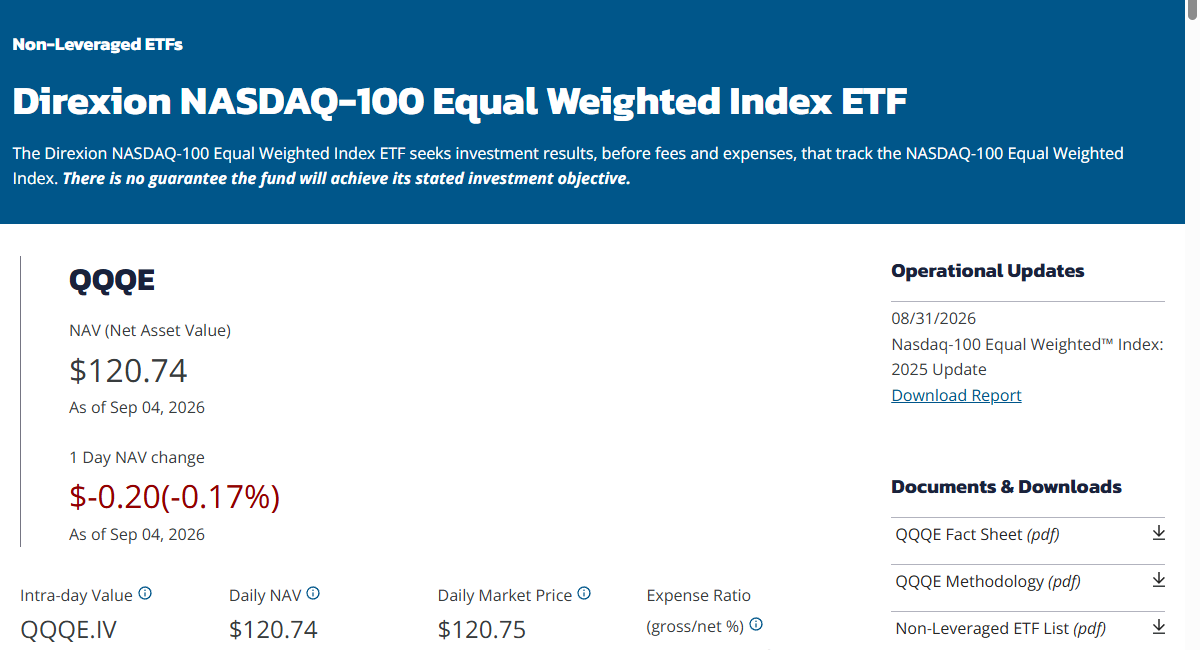
The issuer explains that this equal-weighted index initially assigns about 1% to each company at quarterly rebalances. Price moves can change those weights between rebalances. That is different from every stock remaining exactly 1% every day. Different weights can produce different returns even with many of the same companies.
NAV in the screenshot means net asset value per fund share; Market Price refers to the traded fund share price. Neither is an index level. Continue to Index Information and Downloads to check the full benchmark description, fees and holdings dates. If the page shows only the top ten positions, find the complete holdings download before drawing conclusions about the entire fund.
Turn two fund names into combined holdings
Once the market quote is clear, owning two index funds raises another question: did the second fund add companies or increase positions you already had? Complete holdings can answer that; benchmark names alone cannot.
A search for “nasdaq sp500 overlap” can lead you to discussions of shared holdings, but your own calculation should use complete issuer holdings with the same as-of date. Different fund names can conceal many of the same large companies. Counting common names does not tell you how much of your portfolio they represent.
Assume two unleveraged funds that directly own stocks. All numbers below are illustrative. Your portfolio is 60% Fund A and 40% Fund B. One stock is 7% of A and 12% of B. Your combined exposure to it is:
60% × 7% + 40% × 12% = 4.2% + 4.8% = 9%
That 9% measures this stock’s share of the whole portfolio. If you own it directly as well, include the direct position using the same total-portfolio denominator and ensure all allocation weights are recalculated consistently. A second fund does not automatically diversify away companies you already own.
Use the downloaded holdings to finish the calculation
- Find Holdings or Downloads on each issuer’s site, obtain the complete files and record their as-of dates. Find a common date where possible; if you can only obtain different dates, label the result an approximation.
- Keep each security’s identifier, company name and fund weight. Check percentage units: 7% enters the calculation as 0.07, not 7.
- Match the same stock across both files and repeat the formula row by row. For company-level concentration, combine exposure through separate share classes of that company instead of treating them as unrelated businesses.
- Inspect the largest combined holdings. Distinguish newly added companies from extra weight in shared companies. Calculate sector concentration separately: two stocks in one sector are not the same holding, and sector concentration is not a stock-overlap percentage.
A top-ten list supports checks on those large positions, not a complete overlap claim. Keep cash as a separate item. If a fund obtains exposure mainly through futures, swaps or other derivatives, its reported holdings weights may not measure underlying equity exposure; the direct-stock formula is then insufficient. Read the issuer’s exposure explanation before applying it.
Interpreting the combined weights
The calculation should leave you able to say which companies the second fund adds and how much it increases exposure to companies you already hold. That is more informative than saying you own two fund tickers. Whether the resulting concentration suits your purpose remains a separate decision.
This combined-position calculation is not a universal “fund overlap score.” Different comparison services may define overlap differently. Read their method, and keep the actual weights in your portfolio visible when interpreting a score.
Educational content. Calculation examples use stated assumptions; linked rules and dated screenshots are identified in context. Check current account and product terms before acting. Content reviewed September 9, 2026.