Home › Learn › Cash vs margin accounts
Cash account vs margin account: what is the differenceT+1 settlement, good faith violations, margin calls and the 2026 rule that replaced PDT
Most people pick the default in the "account type" box when they open a brokerage account. They only look again when a sale cannot be reused straight away, a "good faith violation" warning appears, or someone mentions PDT and $25,000. This guide puts the two account types side by side, then works through three examples: settlement limits in a cash account, borrowing and margin calls in a margin account, and what did and did not change when FINRA replaced the pattern day trader rules with intraday margin requirements on June 4, 2026.
Table of contents
- The short answer: how the two accounts differ
- Cash accounts: sale proceeds must settle first
- Two cash-account violations: GFVs and freeriding
- Margin accounts: how the borrowed money works
- When prices fall: maintenance margin and margin calls
- The old PDT rule: four day trades and $25,000
- From June 4, 2026: intraday margin replaces PDT
- Transition to October 20, 2027: which rules your broker uses
- Do day trades in a cash account count?
- If you live outside the US
- Choosing: three questions first
- After a warning, restriction or margin call
- Common questions
The short answer: how the two accounts differ
A cash account only uses money you have deposited. A margin account lets you borrow from the broker to buy, and it is usually required for short selling and many option strategies. The table follows US rules and common broker practice; limits, rates and permissions vary and can be stricter, so check them against your account agreement.
| Item | Cash account | Margin account |
|---|---|---|
| Borrowing to buy | No; settled cash only | Yes; at least $2,000 equity to use leverage |
| Reusing sale proceeds | Limited by settlement; T+1 for regular US trades | Usually available to buy again at once (buying-power rules apply) |
| Short selling | No | Yes, with extra broker approval |
| Day-trading limits | Settlement rules (GFVs, freeriding) | Old PDT rules; intraday margin requirements phased in from 2026-06-04 |
| Interest | None without a loan | Charged on the borrowed balance |
| Worst case | You lose what you put in | Losses can exceed your deposit; the broker can sell without notice |
In one line each: a cash account is limited by money that has not settled; a margin account is risky because the money is borrowed. Having a margin account does not mean every trade uses a loan. A debit balance only appears when you buy more than your settled cash.
Cash accounts: sale proceeds must settle first
The standard US settlement cycle moved from T+2 to T+1 on May 28, 2024: shares and cash change hands on the business day after the trade. The SEC statement on T+1 gives the date. Weekends and US market holidays do not count, so a Friday sale usually settles on Monday.
A timeline example
Assume (illustrative numbers): before Monday's open, the cash account has $0 settled cash and holds stock A worth $1,000.
- Monday morning you sell stock A for $1,000. It shows as unsettled cash and settles on Tuesday.
- Monday afternoon you buy stock B with that $1,000. Most brokers allow this, because the A proceeds arrive before payment for B is due.
- The problem is the next step: selling B again before Monday's close. The money used to buy B has not settled, yet B is already sold. That is the good faith violation described below.
Selling B on Tuesday, after the A proceeds settle, is fine. Many broker apps show "cash available to trade", "settled cash" and "cash available to withdraw" separately. Before an order, the settled-cash figure is more useful than total account value.
Two cash-account violations: GFVs and freeriding
Good faith violation (GFV)
FINRA's investor guide describes it as buying a security with cash from a sale that has not settled, then selling that security before the funds used to buy it have settled. Buying B and selling it on the same Monday is the textbook case.
What happens after one or more GFVs is set by each broker's own policy; regulators do not fix a count. A common response is to restrict the account to settled-cash purchases for a period. Search your broker's help centre for "good faith violation" for the actual count and length, and do not assume another broker's numbers apply.
Freeriding
Freeriding is more serious: buying without paying, selling, and using the sale proceeds to pay for the purchase. For example, with no cash in the account you buy $1,000 of stock C on Monday, sell it the same day, and settle the purchase with the sale proceeds. The SEC investor bulletin "Trading in Cash Accounts" (updated August 7, 2026) says this is not permitted under the Federal Reserve's Regulation T and may lead the broker to freeze the account for 90 days. During the freeze you can still buy, but each purchase must be fully paid on the trade date.
| Situation | Violation? | Typical consequence |
|---|---|---|
| Buy with settled cash, sell the same day | No | None |
| Buy with unsettled proceeds, sell after they settle | No | None |
| Buy with unsettled proceeds, sell before they settle | GFV | Warning or restriction under broker policy |
| Buy without paying, pay with the sale proceeds | Freeriding | Possible 90-day freeze; purchases paid in full on trade date |
The fix is unglamorous: before trading actively in a cash account, confirm you are using settled cash. When unsure, wait until settlement day to sell.
Margin accounts: how the borrowed money works
According to the SEC bulletin "Understanding Margin Accounts", Regulation T lets you borrow up to 50% of the purchase price of marginable securities (the "initial margin"). FINRA requires a deposit of at least $2,000 or 100% of the purchase price, whichever is less, before you use margin. Brokers can be stricter, and some stocks cannot be bought on margin at all.
Example: a $10,000 purchase
Assume you deposit $5,000 and buy 100 shares at $100, $10,000 in total, with $5,000 borrowed.
- Equity = market value − loan =
10,000 − 5,000 = $5,000. - Price rises 10% to $110: market value 11,000, equity
11,000 − 5,000 = 6,000. Your own money is up 20%. - Price falls 10% to $90: market value 9,000, equity
9,000 − 5,000 = 4,000. Your own money is down 20%.
Gains and losses are doubled, and the $5,000 loan accrues interest daily at the broker's published rate, which many brokers tier by balance. The longer you hold, the more the interest eats into any gain.
When prices fall: maintenance margin and margin calls
After the purchase, the account must keep a minimum equity ratio, the "maintenance margin". FINRA's floor is 25% of the market value; the SEC bulletin notes many brokers set 30% to 40%. Fall below it and you get a margin call.
Using the same example: the trigger price
The loan stays at $5,000. With share price P, market value is 100P and equity is 100P − 5,000.
| Maintenance level | Trigger price | Change from $100 | Your equity left |
|---|---|---|---|
| 25% (FINRA minimum) | $66.67 | −33.3% | $1,666.67 (−66.7%) |
| 30% (common broker level) | $71.43 | −28.6% | $2,142.86 (−57.1%) |
| 40% (stricter level) | $83.33 | −16.7% | $3,333.33 (−33.3%) |
Method: (100P − 5,000) ÷ 100P = maintenance level; at 30%, P = 5,000 ÷ (100 × 0.7) ≈ 71.43. A drop of under 30% in the share price wipes out more than half of your own money.
Two points from the SEC bulletin matter most: the broker can sell securities in a margin account without notifying you, and you are not entitled to an extension on a margin call. "Waiting for a bounce" is often not an option you get to choose.
The old PDT rule: four day trades and $25,000
A day trade is buying and selling (or shorting and covering) the same security on the same day. The old rule, as set out in the SEC bulletin "Margin Rules for Day Trading", made you a pattern day trader if you made four or more day trades within five business days in a margin account, provided they were more than 6% of your total trades in that account over the same period.
- A pattern day trader needed at least $25,000 of equity; below that, no more day trading.
- Day-trading buying power was up to four times maintenance margin excess. Exceeding it brought a day-trading margin call, to be met within five business days.
- If unmet, the account was restricted to cash-available trading for 90 days or until the call was met.
This is where "you cannot day trade US stocks with a small account" comes from. It was formally replaced in 2026, but during the transition below your broker may still apply it.
From June 4, 2026: intraday margin replaces PDT
The SEC approved FINRA's rule change on April 14, 2026 (Release No. 34-105226, file SR-FINRA-2025-017). FINRA Regulatory Notice 26-10 set June 4, 2026 as the effective date and says the change replaces the day trading margin requirements in their entirety, including the trade-count test for pattern day traders and the $25,000 minimum equity.
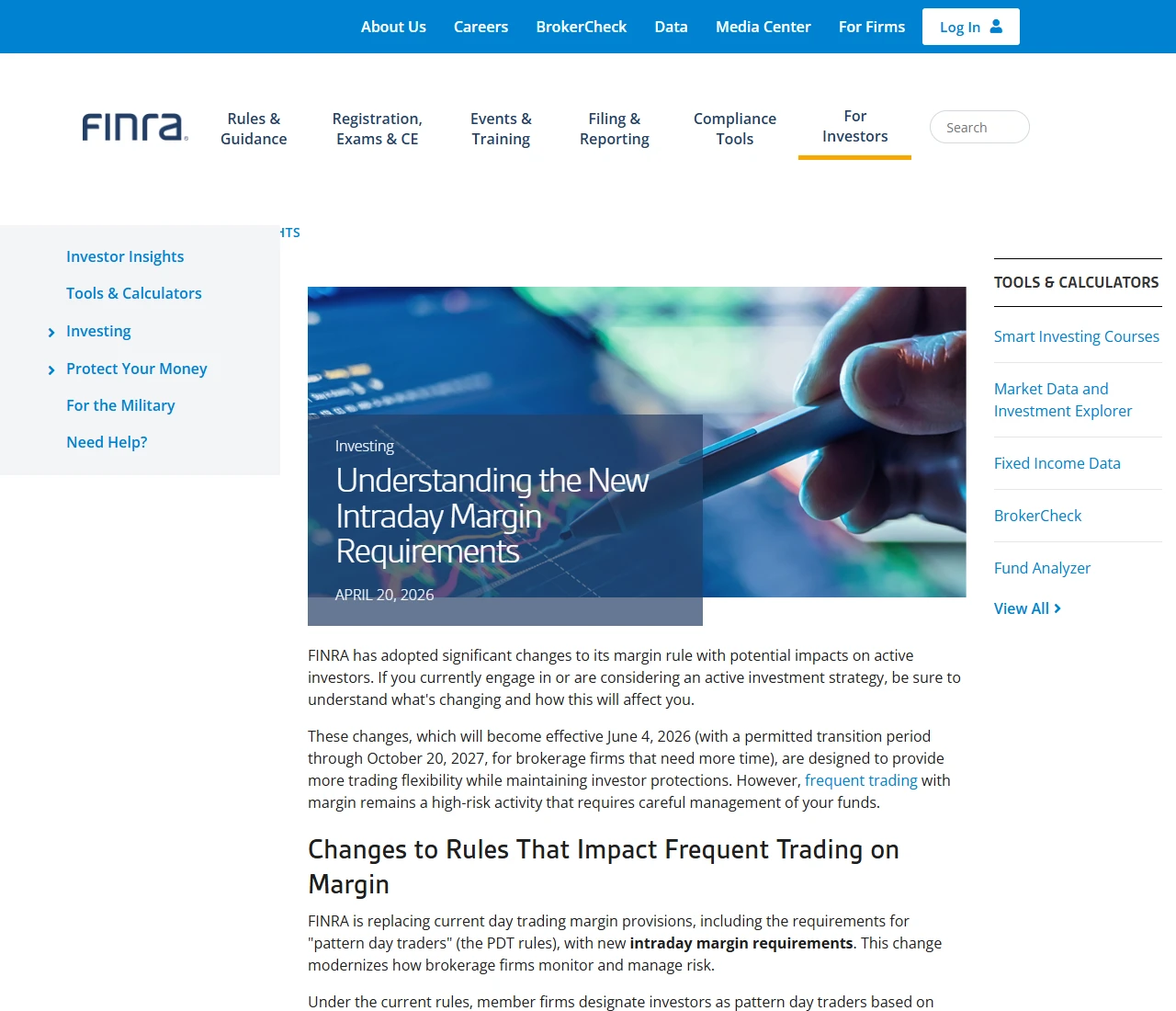
What changed, per FINRA's investor guide
- No $25,000 minimum for day trading.
- No PDT designation by trade count. The firm monitors whether your equity covers your actual positions during the day.
- Intraday margin deficits must be met promptly. If equity does not cover open positions intraday, you have a deficit to satisfy as soon as possible.
- Maintenance margin applies all day. The 25% requirement is checked throughout the trading day, not just at the close; firms can set it higher.
- Repeated failures lead to restrictions. FINRA's investor page says the account may be restricted for up to 90 days. Notice 26-10 states that if a deficit is not met by the close of business on the fifth business day after it occurs, the firm must prevent new debit balances or short positions for 90 calendar days.
What did not change
Using leverage still needs $2,000 of equity; below that, a margin account trades with available cash only. Regulation T's 50% initial margin and the cash-account settlement rules (GFVs, freeriding) are untouched. FINRA adds that the new requirements typically cover all margin-account activity during the day, including margin used for zero-day-to-expiration (0DTE) options.
Firms get flexibility in how they apply it: they can monitor in real time and block orders that would create a deficit, or compute the requirement after the close and call for margin from accounts that had a deficit, or combine both. So whether you can day trade with a small margin account now depends on which method your broker picked and its house rules.
Transition to October 20, 2027: which rules your broker uses
FINRA gave firms an 18-month transition, to October 20, 2027. Some brokers have switched; others still run the old PDT rules. "PDT is gone" may not yet be true for your account.
- Look at the account screen. A "day trades left" counter or "PDT status" usually means the old rules still apply.
- Search the help centre for "intraday margin", "pattern day trader" or "PDT rule change", and look for a switch-over date.
- Check emails and in-app notices. Brokers usually announce the change and the new deficit process.
- Ask support directly: "Does my account use the old PDT rules or the new intraday margin requirements?" "If I have an intraday deficit, do you block orders in real time or call for margin after the close?" "How many business days do I have to meet it, and what is the restriction if I don't?"
Keep the reply as a screenshot or email. If a restriction is ever disputed, a written answer carries more weight than a phone call.
Do day trades in a cash account count?
The old PDT definition counts day trades "in the margin account", and the new requirement applies to each margin account of a customer, other than good faith and portfolio margin accounts, according to the SEC approval order. Our inference: a pure cash account is not subject to PDT or the new intraday margin requirement. That follows from the rules' scope; we did not find an official sentence saying "PDT does not apply to cash accounts" in those words.
That does not make a cash account a day-trading account. The settlement rules in the third section still apply: you can only trade repeatedly with settled cash, and under T+1 money used for a round trip today is available again on the next business day. Some brokers also set their own day-trading limits on cash accounts, so read the terms.
If you live outside the US
Regulation T and FINRA rules bind US-registered broker-dealers (FINRA members). What matters is not where you live but which legal entity holds your account.
- If the account is with a US-registered broker-dealer, these rules generally apply even if you live in Asia or Europe. Search the firm in FINRA BrokerCheck to see whether it is a FINRA member.
- Many brokers serve overseas clients through subsidiaries in Hong Kong, Singapore, the UK or elsewhere. Those accounts follow local regulation and that company's margin policy, which can differ from the US. The full company name in your client agreement is the entity that holds your account.
- Tokenized stocks and stock perpetuals bought on crypto platforms are not traded in a US broker's cash or margin account, so these rules do not apply; they have their own leverage and liquidation mechanics. See tokenized stocks vs real shares.
Choosing: three questions first
These are suggestions, not the only right answer:
- Do you plan to borrow to buy? If not, a cash account is enough and rules out margin calls and forced sales entirely.
- Will you buy and sell within the same day often? If so, cash-account settlement will get in the way. A margin account is more flexible, but first confirm which rules your broker applies during the transition.
- Can you accept losing more than you deposited? In extreme moves a margin loan can exceed the value of the holdings, and you owe the difference. If not, do not use leverage.
For people new to US stocks, our suggestion is a cash account, or a margin account with the borrowing left unused, until you understand the interest, the maintenance level and how your broker liquidates. Many brokers let you upgrade a cash account to margin later, and some allow the reverse, through settings or support.
After a warning, restriction or margin call
A GFV or freeriding notice
- Read the notice itself: which trade, which date, which violation.
- Find the matching policy in the broker's help centre to confirm the count and the restriction length.
- During a restriction, buy only with settled cash; during a freeriding freeze, pay for each purchase in full on the trade date.
- If you think it is wrong (for example the funds had settled), save screenshots of the trades and contact support in writing.
A margin call
- Log in now and check the amount and deadline. The SEC bulletin says the broker can sell without waiting for the deadline and without notice, so act early.
- You have three options: deposit cash, deposit marginable securities, or sell some holdings yourself. Selling yourself lets you choose what and how much; a forced sale is the broker's choice.
- Afterwards, confirm your equity is back above the requirement, and watch the next session's open: another drop can trigger a new call.
If you disagree with how it was handled
FINRA's complaint page sets out the order: ask your broker first; if not satisfied, contact the branch manager or compliance department and complain in writing, keeping copies of all correspondence; if still unresolved, file through FINRA's complaint program. If your account is held by a non-US entity, complain to that country's regulator; FINRA may not have jurisdiction.
Common questions
Has the PDT rule been abolished?
At rule level it was replaced by intraday margin requirements on June 4, 2026, but firms can transition until October 20, 2027 and may still apply the old PDT rules meanwhile. Check your own account screen and broker notices rather than headlines.
Can I day trade with a few hundred dollars in a margin account now?
Not with leverage: margin needs at least $2,000 of equity. Below that, a margin account trades with available cash only, and how often you can trade still depends on your broker's method.
When can I withdraw cash after selling in a cash account?
Only after settlement (T+1), and the broker may add its own deposit holds or review time. See how long withdrawals take after a sale.
Can I get a margin call in a margin account without borrowing?
Generally not, if there is no debit balance and no margin tied up by short positions or options. Margin calls relate to borrowed or margin-backed positions.
Educational content, not investment advice. Calculation examples use assumed numbers; rule descriptions come from public SEC and FINRA documents, and the screenshot is dated. Brokers can apply stricter standards than regulators, so read your own account agreement and notices before opening an account or trading. Content reviewed October 8, 2026.