Home › Learn › Stock market circuit breakers
How US stock market circuit breakers workThe 7%, 13% and 20% levels, how long trading stops, and what happens to your orders
A US market-wide circuit breaker looks at one number: how far the S&P 500 has fallen from the previous trading day’s close. A 7% drop halts trading for 15 minutes, 13% halts it for another 15 minutes, and 20% closes the market for the rest of the day. After 3:25 p.m. Eastern, the first two levels no longer halt anything. Single stocks have a separate system, Limit Up-Limit Down (LULD), which pauses only that stock, usually for five minutes.
Table of contents
The three levels: how far, how long
The reference point is the S&P 500’s closing value on the previous trading day. The NYSE publishes the three trigger values before the open. If the index falls to one of them during regular hours, every US stock and options exchange stops trading at the same time.
| Level | S&P 500 decline from prior close | Triggered 9:30 a.m.–3:25 p.m. ET | Triggered 3:25–4:00 p.m. ET |
|---|---|---|---|
| Level 1 | 7% | Market-wide halt for 15 minutes | No halt, trading continues |
| Level 2 | 13% | Another 15-minute halt | No halt, trading continues |
| Level 3 | 20% | At any time, trading stops for the rest of the day | |
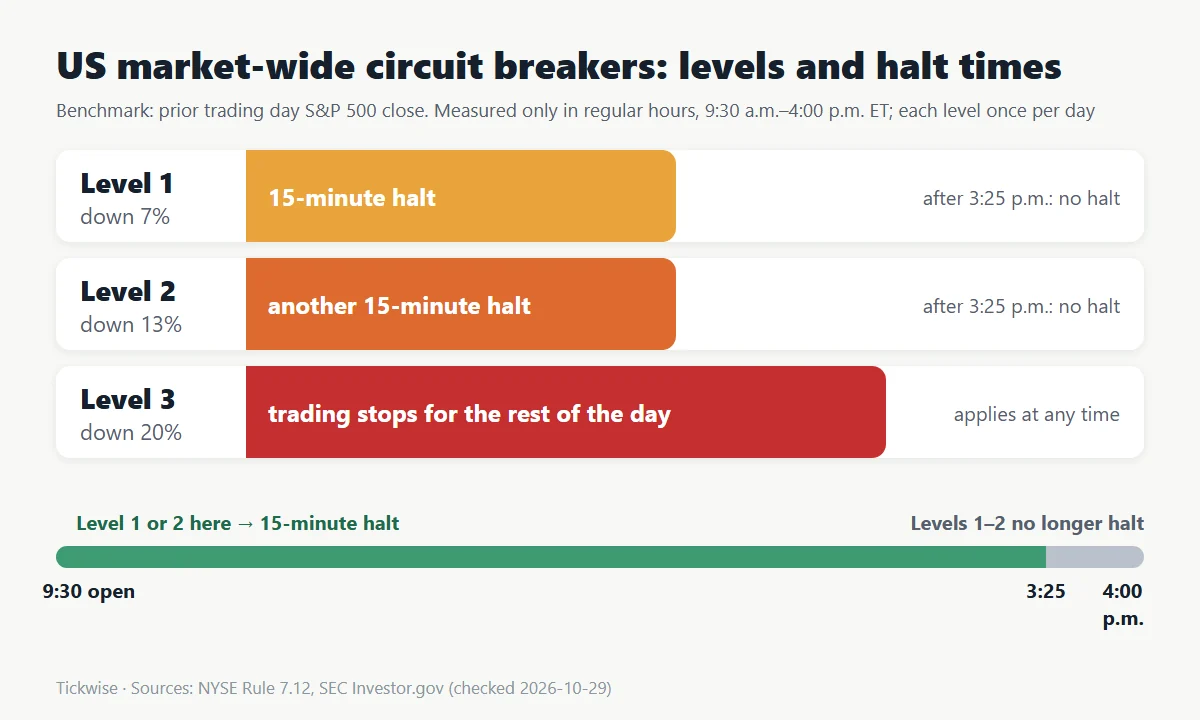
A few details people often get wrong:
- Each level can trigger only once per day. If trading resumes after Level 1 and the index slides back toward 7%, nothing happens until it reaches 13%.
- It is the S&P 500, not the Dow or the Nasdaq. A 7% fall in the Nasdaq Composite does not halt the market if the S&P 500 is down less. See how the three indexes differ.
- How long a Level 3 halt lasts: in September 2026 the NYSE amended Rule 7.12, as venues move toward near-24-hour trading, so that after Level 3 trading resumes no earlier than 4:00 a.m. ET on the next trading day, which in practice keeps the old “closed for the day, open again tomorrow” outcome.
- Only regular hours count. Pre-market (4:00–9:30 a.m.) and after-hours (4:00–8:00 p.m.) trading are not covered. A deep pre-market drop does not trigger a halt by itself; the levels are measured once the regular session is open.
The 3:25 p.m. cut-off in your time zone
New York switches between Eastern Daylight Time (UTC−4, from the second Sunday of March to the first Sunday of November) and Eastern Standard Time (UTC−5). Converted to UTC, then add your own offset:
| Moment | New York (ET) | UTC, US daylight time | UTC, US standard time | Singapore / Hong Kong (UTC+8) |
|---|---|---|---|---|
| Regular open | 9:30 a.m. | 13:30 | 14:30 | 21:30 or 22:30 |
| Levels 1–2 stop halting | 3:25 p.m. | 19:25 | 20:25 | 03:25 or 04:25 next day |
| Close | 4:00 p.m. | 20:00 | 21:00 | 04:00 or 05:00 next day |
If you are in Europe, remember that Europe and the US change clocks on different weekends, so for a week or two in spring and autumn the gap to New York is one hour shorter than usual. In 2026 the US leaves daylight time on 1 November. The US market hours tool converts the session to your own clock.
What happens to your open orders
Nothing trades during a halt, but a halt does not automatically cancel every order. What you see depends on exchange rules and on your broker:
- Resting limit orders usually stay on the exchange or with the broker and take part in the reopening. Some brokers reject new orders or cancel certain order types during a halt; their notice tells you which.
- Orders placed during the halt may be accepted and queued until trading resumes, or rejected outright. Whether you can cancel, and how quickly the cancel is confirmed, also depends on the broker.
- Stop orders can fill far below the stop price if the reopening price gaps through it, because a triggered stop becomes a market order.
- The reopening price comes from an auction that matches the orders built up during the halt. It can be well away from the last trade before the pause.
Quotes jump and spreads widen in the first minutes after a reopening. A market order then often fills worse than the number on your screen; a limit order states the worst price you will accept. The pre-market and after-hours guide walks through a 50-share limit order step by step.
Single-stock halts: LULD and news pauses
When a headline says a single stock “hit a circuit breaker”, it usually means a Limit Up-Limit Down pause, which is a separate rule:
| Market-wide circuit breaker | LULD single-stock pause | |
|---|---|---|
| Measured against | The S&P 500’s prior close | The stock’s average price over the previous five minutes |
| Thresholds | 7% / 13% / 20% | Generally ±5% for Tier 1 (S&P 500, Russell 1000 and many ETFs) priced above $3; ±10% for Tier 2; wider bands for low-priced stocks |
| Upward moves | No, declines only | Yes, a jump through the upper band also pauses |
| Length | 15 minutes or the rest of the day | If the price stays outside the band for 15 seconds, a 5-minute pause; bands double in the last 25 minutes |
| Scope | Every US stock and options exchange | That one stock |
Exchanges can also halt a single stock while news is pending or information is unclear (codes such as T1 or T12). Those halts have no fixed length and are not triggered by price. If a holding is halted, check the halt code on the exchange’s trading-halt page first, then the company’s own announcements.
Every time the breakers have fired
Circuit breakers exist because of 19 October 1987, “Black Monday”, when the Dow fell about 22.6% in one session with no pause of any kind. Exchanges adopted halts in October 1988, first in Dow points and later at 10%, 20% and 30%. In 2012 the SEC approved today’s S&P 500-based 7/13/20% levels and cut the pauses from 30–120 minutes to 15.
| Date | What happened |
|---|---|
| 27 Oct 1997 | First trigger: at 2:36 p.m. a 350-point Dow drop halted trading for 30 minutes; at 3:30 p.m. a fall to 550 points closed the market early, down about 7.2% on the day (old Dow-point rules) |
| 9 Mar 2020 | Pandemic fears and an oil price collapse: the S&P 500 hit −7% minutes after the open, 15-minute halt |
| 12 Mar 2020 | Level 1 again shortly after the open, 15-minute halt |
| 16 Mar 2020 | Level 1 at the open, 15-minute halt; the index closed down about 12% |
| 18 Mar 2020 | Level 1 at 12:56 p.m., 15-minute halt |
So under today’s rules only Level 1 has ever fired, all four times within ten days in March 2020. Levels 2 and 3 have never been triggered. Halts are rare, but when they happen they tend to come in clusters, which hurts most if you are leveraged.
How other markets compare
The best-known contrast is China’s A-share market in January 2016. Its breaker paused trading at a 5% fall in the CSI 300 and closed the market at 7%. Both closes happened within a week, on 4 and 7 January, and the mechanism was suspended from 8 January. The two designs differ in three ways:
- Distance between levels: 5% and 7% were so close that a first pause often led straight to the second. In the US the first pause comes at 7% and a full close only at 20%.
- End-of-day rule: after 3:25 p.m. the US skips Levels 1 and 2, so a late pause does not cram all trading into the last minutes.
- Single-stock layer: LULD handles sharp moves in one stock without stopping the whole market.
Other exchanges, for example in Japan, Korea and India, run their own systems with different thresholds. If you trade there, read that exchange’s rules rather than assuming the US numbers.
If a halt hits while you hold stocks
- Check your open orders first. Look at what is still working and how much has filled. Orders can execute the moment trading resumes; cancel what you no longer want and wait for the cancel confirmation.
- Avoid market orders at the reopening. Use a limit order with the price you are willing to accept.
- On margin, watch your maintenance requirement. A sharp drop can trigger a margin call, and the broker may sell positions for you at market. See cash vs margin accounts.
- Tokenized stocks and stock-linked contracts follow their platform’s rules. Whether they pause with the NYSE, keep trading, or reopen at a particular price is set by each platform and may not match the exchange. See tokenized stocks vs real shares.
- A halt is not a forecast. It pauses the market for minutes; it does not tell you whether prices will keep falling or bounce. If you invest on a schedule, decide in advance whether a crash day changes your contribution, rather than deciding during the halt.
Sources
- SEC Investor.gov: measures that protect investors during market volatility (circuit breakers and LULD)
- SEC 2012 press release approving the 7%, 13% and 20% levels
- SEC 1998 report on the market events of 27–28 October 1997
- Market-wide circuit breaker working group report, 2021 (timing of the March 2020 triggers)
- The LULD Plan (price bands and trading pauses)
Levels, the 3:25 p.m. rule, LULD bands and pause length come from the official pages above. The September 2026 change is SEC Release 34-106380 (SR-NYSE-2026-43). The 2016 China episode is from the Shanghai and Shenzhen exchanges’ notices at the time.
For learning only, not investment advice. Rules are taken from current exchange and SEC documents; time-zone rows assume the usual daylight-saving alignment. Content checked on 2026-10-29.