What is an ADR stock? TSMC's TSM, explained step by stepHow many shares one ADR represents, why TSM trades above Taiwan, and what ADR fees and foreign withholding take from dividends
Search for TSMC in a US brokerage app and you get the ticker TSM, at a price that does not match the Taiwan-listed 2330 and is usually higher. What you are buying is not the Taiwan share itself but an American depositary receipt (ADR): a US bank holds the shares in Taiwan and issues a dollar-traded certificate in the US. To understand an ADR you need four answers: how many shares one represents, why the price carries a premium, who charges fees, and what is taken out of the dividend before it reaches you.
Table of contents
- The short answer: what an ADR is
- One TSM equals five TSMC shares: how ratios work
- Why TSM costs more than the Taiwan shares
- Two markets that never overlap: time zones and currency
- Not all ADRs are alike: sponsored, unsponsored, Level 1/2/3
- ADR fees: who charges them and how they are collected
- How the dividend arrives: TSM's October 2026 payment
- Voting, converting back, and the extra risk in Chinese ADRs
- Checks before you buy an ADR
- FAQ
The short answer: what an ADR is
The SEC's investor education site, Investor.gov, defines an ADR as a security that represents shares of a non-US company held by a US depositary bank outside the United States. ADRs are quoted in US dollars and clear through US settlement systems, so holders do not have to deal in a foreign currency or open an account abroad. You will also see "ADS" (American depositary share): strictly, the ADS is the share and the ADR is the certificate that evidences it. Most people use the two interchangeably, and so does this guide.
TSMC side by side:
| Item | Taiwan: 2330 | US: TSM |
|---|---|---|
| Where it trades | Taiwan Stock Exchange | New York Stock Exchange |
| What you own | TSMC common shares | A depositary receipt for TSMC common shares; 1 ADR = 5 shares |
| Currency | New Taiwan dollar | US dollar |
| Trading hours | 9:00–13:30 Taipei time | 9:30–16:00 US Eastern time |
| Dividends | Paid in NT dollars per share | Converted to US dollars by the depositary, after Taiwan withholding |
| Extra fees | No depositary fee | Depositary fees allowed under the deposit agreement |
One common mix-up: ASML's Nasdaq listing is registered ordinary shares held through a New York transfer agent, not an ADR. When a foreign company is listed in the US, check whether the listing is an ADR or ordinary shares first, because the ratio, fee and dividend points below apply only to ADRs.
One TSM equals five TSMC shares: how ratios work
An exhibit to TSMC's Form 20-F states that each ADS represents five common shares on deposit with the custodian. The depositary is Citibank, N.A. in New York and the custodian is Citibank Taiwan. According to TSMC's annual report, about 1.06 billion ADSs were outstanding at February 28, 2025.
The conversion: Taiwan price × 5 ÷ NT$ per US$ = Taiwan value of one TSM, in US dollars.
Ratios differ from company to company, so look each one up:
| Company | US ticker | One ADR equals | Main home listing |
|---|---|---|---|
| TSMC | TSM | 5 common shares | Taiwan Stock Exchange (2330) |
| Alibaba | BABA | 8 ordinary shares | Hong Kong Stock Exchange (9988) |
| Toyota | TM | 10 common shares | Tokyo Stock Exchange |
| Sony | SONY | 1 common share | Tokyo Stock Exchange |
| Novo Nordisk | NVO | 1 B share | Nasdaq Copenhagen |
Ratios can change. After a split or consolidation the depositary may adjust the ratio or leave it alone: when Sony split its shares in Japan in 2024, the ADR ratio stayed at 1:1. Before converting, read the ratio in the depositary's latest notice or the company's latest annual report.
Why TSM costs more than the Taiwan shares
Here is the calculation with official closing data from October 8, 2026:
- 2330 closed at NT$2,550 (Taiwan Stock Exchange);
- the US dollar bought NT$31.94 that day (Federal Reserve H.10 rate);
- Taiwan value of one TSM:
2,550 × 5 ÷ 31.94 ≈ US$399.19; - TSM closed in New York at US$457.99, about 14.7% above that.
A week later, on October 16, 2330 closed at NT$2,420, worth about US$374.30 at roughly 32.33 (a third-party rate), while TSM closed at US$412.61: a premium of about 10.2%.
The premium moves around. Bloomberg data showed an average premium of about 13.7% in May 2026 and about 26% in December 2025. A Goldman Sachs note from August 2025 said the premium had widened sharply since 2023, peaking in the high-20% range, after years when 10% to 20% was typical; in 2025 the range shifted to roughly 15% to 25%.
Why can it stay so wide? One reason Goldman cited is that TSMC ordinary shares cannot be freely converted into ADRs, so arbitrageurs cannot buy in Taipei, convert, and sell in New York to close the gap. Another is that investor demand differs between the two markets.
For a buyer, the price you pay for TSM includes a premium that can change at any time. When the premium narrows, TSM can fall even if the Taiwan shares do not. In the week above, 2330 fell about 5.1% while TSM fell about 9.9%; part of the extra drop was the premium shrinking from 14.7% to 10.2%.
A caution on the arithmetic: Taiwan closes at 13:30, more than half a day before New York, and the exchange rate is never taken at the same moment, so a "same-day premium" is an approximation. The trend tells you more than the decimals.
Two markets that never overlap: time zones and currency
The Taiwan Stock Exchange's regular session runs 9:00–13:30 Taipei time; the NYSE core session runs 9:30–16:00 Eastern time. In October, with US daylight saving time, the gap is 12 hours: when Taiwan closes at 13:30 it is 1:30 a.m. in New York, and when TSM opens at 9:30 it is already 9:30 p.m. in Taipei. The two sessions never overlap.
News that lands after the Taiwan close, such as a move in US chip stocks or a US data release, shows up in TSM that evening and in 2330 the next morning. That is why TSM often looks as if it has "already traded" Taiwan's next session.
The exchange rate is the other moving part. The SEC's international investing bulletin warns that a foreign investment can rise in its home market and still be worth less in US dollars. In the week above, 2330 fell about 5.1% in NT dollars, the NT dollar weakened at the same time, and the drop in US-dollar terms widened to about 6.2%.
Roughly: TSM's move ≈ Taiwan move × currency move × change in the premium. Buying TSM with dollars means taking all three at once.
Not all ADRs are alike: sponsored, unsponsored, Level 1/2/3
ADRs are sponsored or unsponsored depending on whether the foreign company takes part, and they come in three levels. This table follows Investor.gov's ADR bulletin:
| Level | Where it trades | Can raise capital in the US | Disclosure |
|---|---|---|---|
| Level 1 | Over the counter only | No | Minimal; issuer information may not be on EDGAR |
| Level 2 | A US national exchange | No | Annual report on Form 20-F |
| Level 3 | A US national exchange | Yes | Annual report on Form 20-F |
Exchange-listed ADRs such as TSM and BABA are at least Level 2. Unsponsored ADRs can only be Level 1 and trade only over the counter; a depositary or broker sets them up without the company's cooperation. The catch: holders usually bear all the costs, the depositary is often under no obligation to pass on shareholder communications, and voting rights may not be passed through.
How to spot them: foreign securities quoted over the counter often have five-letter tickers. Under FINRA's symbol conventions a fifth letter Y marks an ADR, while F marks a foreign ordinary share quoted directly, which is not an ADR. With either kind, find out whether it is sponsored, who the depositary is and what it charges before you buy.
ADR fees: who charges them and how they are collected
The depositary holds the shares, handles dividends and corporate actions, and charges fees under the deposit agreement. Investor.gov's example: fees are usually charged per ADR, and 1,000 ADRs might cost US$20 to US$50, or 2 to 5 cents each. Schwab puts the average at 1 to 3 cents per share.
There are two ways the fee reaches you:
- Dividend-paying ADRs: the depositary often deducts the fee from the dividend, so the amount you receive is already net of it.
- ADRs with no dividend, or one too small to cover the fee: DTC, the US securities depository, charges the broker, which passes the charge on to your account. Firstrade's help page says these fees are passed through automatically and appear on the monthly statement as "ADR Pass-Thru Charges."
For TSM, the depositary-fees section of TSMC's 20-F lists caps of up to US$0.05 per ADS for issuing or cancelling ADSs and up to US$0.02 per ADS held for cash distributions such as proceeds from selling rights. For the October 2026 ordinary dividend, Citibank's notice showed a depositary fee of zero.
Buying ADRs through Binance's stock trading works the same way. Binance's October 15, 2026 notice listed September ADR fees, mostly US$0.02 per share with some at US$0.01 and US$0.004, and said the fees are typically charged about a month after Binance is charged by the depositary; anyone holding on the record date is charged even if they have sold since.
So before buying an ADR, look up its fee schedule; afterwards, check your statement or account history for lines such as "ADR fee" or "pass-thru."
How the dividend arrives: TSM's October 2026 payment
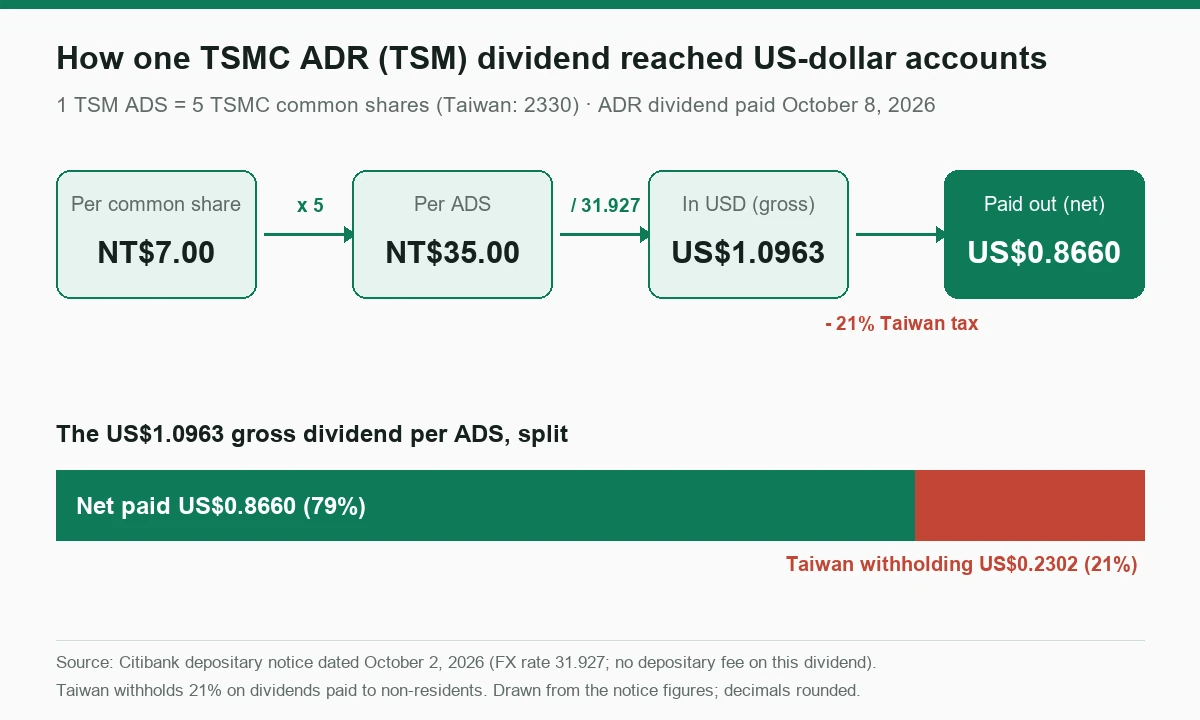
Citibank's TSM dividend notice dated October 2, 2026 sets out each step:
- TSMC paid NT$7.00000137 per common share;
- one ADR represents five shares, so NT$35.00000685 per ADR;
- converted at 31.927, the gross dividend was US$1.096251 per ADR;
- Taiwan withholds 21% on dividends to non-residents: US$0.230213;
- net per ADR: US$0.866038. The ADR record date was September 16 and the payment date October 8.
The notice adds two points worth knowing: when the depositary converts currency itself, its spread is capped at 20 basis points (0.2%), and it has no obligation to obtain the most favourable exchange rate.
For holders who are not US persons, dividends on a foreign company's ADR are generally not subject to US withholding. IRS Publication 515 says dividends paid by a foreign corporation are generally not subject to chapter 3 withholding. That differs from dividends paid by US companies, where non-residents face 30% unless a treaty lowers it; see our dividend withholding guide. What ADR dividends do face is tax in the company's home country:
| Home country | Withholding on dividends | Example |
|---|---|---|
| Taiwan | 21% | TSMC (TSM) |
| Japan | 15.315% on listed-share dividends (except individuals holding 3% or more) | Toyota (TM), Sony (SONY) |
| United Kingdom | Generally none | — |
| China | Depends: for companies incorporated in places such as the Cayman Islands, 10% may apply only if the company is treated as a PRC resident enterprise | Alibaba (BABA) |
A tax treaty may lower the rate, but whether you can use it, and how, depends on the treaty between your country and the company's, and on your broker's process. Brokers also handle these dividends differently in their systems, so check your first payment against the depositary's notice. To estimate what you will receive, use our dividend withholding calculator with the home-country rate.
Voting, converting back, and the extra risk in Chinese ADRs
Voting. ADR holders usually cannot vote at the shareholder meeting directly; they send instructions through the depositary. TSMC's deposit agreement says the depositary disclaims liability for any failure to carry out voting instructions. For most small holders this matters little, but your shareholder rights are indirect.
Converting back. Investor.gov explains that ADRs can be surrendered to the depositary for the underlying shares, and shares can be deposited to create ADRs; brokers and other professionals usually do this, rarely individuals. Limits differ by company. Alibaba says its US ADSs and Hong Kong shares are fully fungible in both directions, usually within about two business days. TSMC ordinary shares cannot be freely converted into ADRs, which is one reason TSM's premium persists.
Delisting risk in Chinese ADRs. The Holding Foreign Companies Accountable Act (HFCAA), passed in 2020, requires the SEC to bar trading in a company's securities if the PCAOB cannot inspect its auditor for two consecutive years (originally three). After a 2022 agreement between US and Chinese regulators, the PCAOB vacated its earlier determinations in December 2022, and the SEC's provisional list is empty (page last updated April 2023). In 2025, though, US policymakers again raised the possibility of forced delistings. As of October 2026 we found no new public determinations, but the risk has not gone away; if you hold a Chinese ADR, check whether the company also lists in Hong Kong and whether the two lines can be converted.
Checks before you buy an ADR
- Find the ratio and the depositary. The cover of the latest 20-F, or the depositary's website, states how many shares one ADS represents and who the depositary is.
- Work out the premium. Home price × ratio ÷ exchange rate gives the equivalent value; compare it with the ADR price, and if the premium is well above its recent range, decide whether you are willing to pay it.
- Exchange-listed or over the counter? NYSE and Nasdaq ADRs are at least Level 2 with full annual reports; for a five-letter OTC ticker ending in Y, check whether it is unsponsored.
- Check the fees. Read the caps in the 20-F's depositary-fees section, then look for "ADR fee" or "pass-through" in your broker's fee schedule.
- Estimate the dividend you keep. Apply the home-country withholding rate, and check your first payment against the depositary's notice.
- Take a second look at Chinese ADRs. Where the company is incorporated, whether it also lists in Hong Kong, whether the lines are convertible, and what would happen to your ADRs on a delisting.
If you have not decided where to buy US stocks yet, start with in-platform stocks versus a broker; to tell ADRs apart from on-chain stock tokens, read our tokenized stocks guide.
FAQ
Is an ADR a stock? How is it different from owning the shares?
An ADR is a certificate representing a foreign company's shares; its price tracks the shares and it trades in dollars. The difference is that you do not hold the shares directly: the depositary converts and pays dividends, votes go through the depositary, and there may be depositary fees.
Why does TSMC's ADR trade above the Taiwan shares?
Mainly because TSMC ordinary shares cannot be freely converted into ADRs, and demand differs between the two markets. On official data for October 8, 2026 the premium was about 14.7%; the December 2025 average was about 26%. It changes all the time.
How much is an ADR fee, and where does it show up?
Typically 1 to 5 cents per ADR. On dividend-paying ADRs it comes out of the dividend; otherwise your broker debits your account, often labelled "ADR Pass-Thru Charges" or similar on the statement.
Do non-US investors pay US tax on ADR dividends?
For a foreign company's ADR, dividends are generally not subject to US withholding for non-US persons, but the company's home country withholds tax, such as 21% in Taiwan or 15.315% in Japan.
What is an unsponsored ADR?
An ADR set up by a depositary or broker without the company's involvement. It trades only over the counter, comes with little information, passes all costs to holders, and may not pass through voting rights.
Educational content, not investment advice or a recommendation of any stock. Premium figures use closing data for October 8 and 16, 2026; dividend figures come from Citibank's notice; rules come from SEC, FINRA and IRS documents and company 20-F filings. Content reviewed October 19, 2026.